Long Form
Ebook to video series
Chapters are a print convention. Episodes are a viewing one, and mapping them one to one is why most book-derived series die at episode three.
Why chapter-per-episode fails
Chapters vary wildly in length — a book with a four-page chapter two and a thirty-page chapter three produces a three-minute episode followed by a twenty-two-minute one. Viewers read that inconsistency as a quality problem even when the content is good.
Chapters also frequently split a single argument across two of them, or bundle three unrelated ones into a single chapter, because print pacing has different constraints. Following that structure means episodes that end mid-thought.
Episode by argument instead
Go through the book and list every distinct claim it makes — usually somewhere between eight and twenty for a business or non-fiction book. Each of those is a candidate episode, regardless of which chapter it lives in.
Then merge the thin ones and split the fat ones until every episode is six to ten minutes. The result no longer matches the table of contents, and that is correct: the table of contents was designed for a reader who can flip back.
- List every distinct claim, ignoring chapter boundaries.
- Target six to ten minutes per episode.
- Each episode must resolve one claim completely.
- Merge thin claims, split multi-claim chapters.
Every episode has to stand alone
A reader starts a book at the beginning. A viewer arrives at episode seven from a recommendation and has no idea what episodes one to six said.
So each episode opens with fifteen seconds of context — what this is part of, and the one thing you need to know from earlier — and closes by resolving its own claim rather than teasing the next. Cliffhangers work for narrative and fail for explanatory content, where the viewer simply leaves.
Publishing cadence
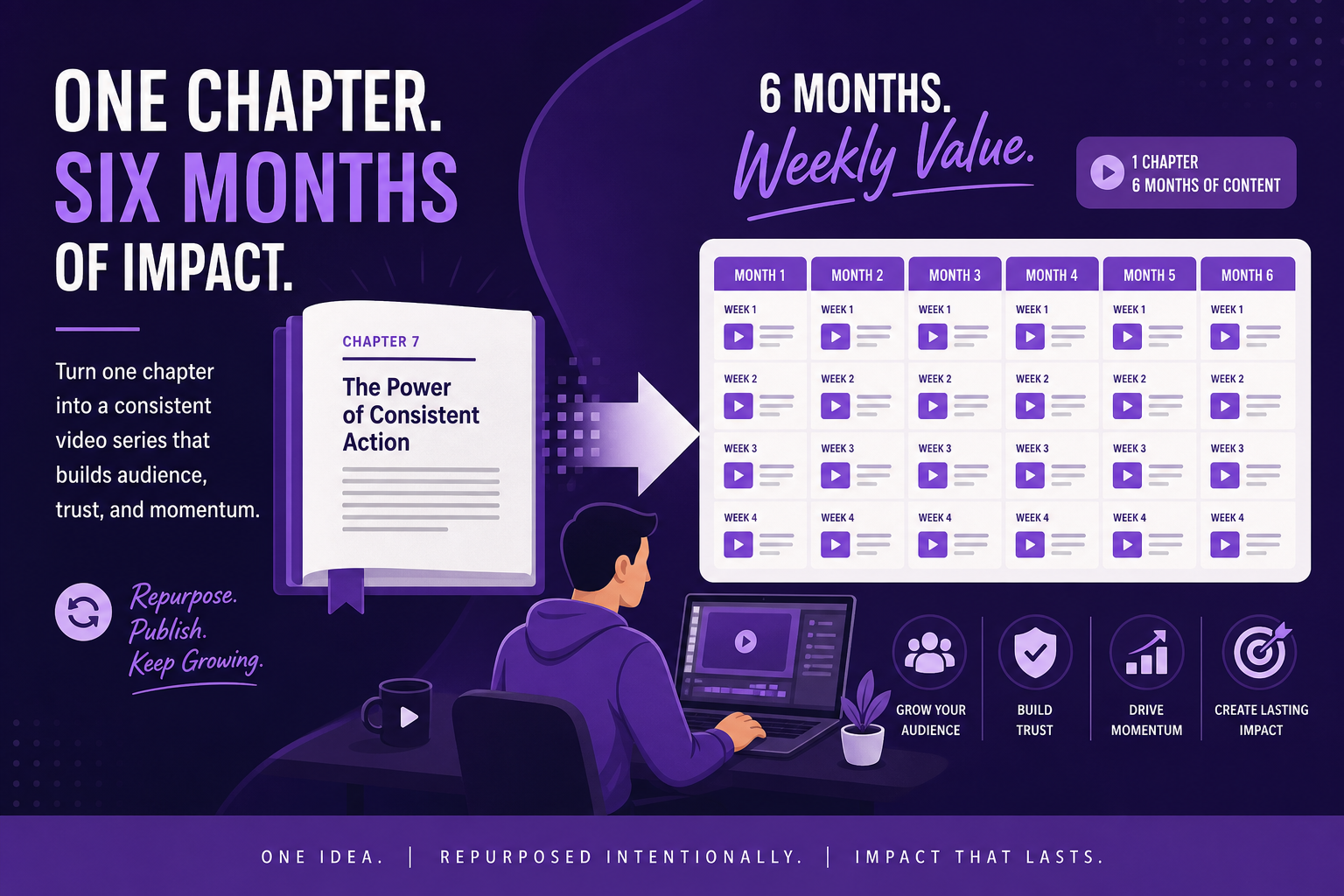
Weekly beats a single dump. A twelve-episode series released at once is a library nobody starts; released weekly it is a reason to return, and each episode gets its own moment in a feed.
Produce them in a batch and schedule them out. The production efficiency of batching and the distribution advantage of a cadence are not in conflict — only the publishing date differs.
What the series is for
Be clear about this before starting. If the series is meant to sell the book, each episode should resolve its claim and make the reader want the depth — which means giving away the conclusions and keeping the evidence and examples in the book.
If the series is the product, it needs the evidence too, and it needs to be substantially longer. Trying to do both produces something that half-explains everything and sells nothing.
Frequently Asked Questions
How many episodes should an ebook become?
Eight to twenty for a typical non-fiction book, driven by how many distinct claims it makes rather than how many chapters it has.
Should episodes follow the book's order?
Usually yes, since the argument builds. But move a strong standalone claim to episode one — the first episode gets the most views and should be the best hook, not the introduction.
Will a video series cannibalise book sales?
Not if the episodes give conclusions and the book keeps the evidence, examples, and detail. The series is discovery; the book is depth.