Comparison
PDF to audio, or PDF to video?
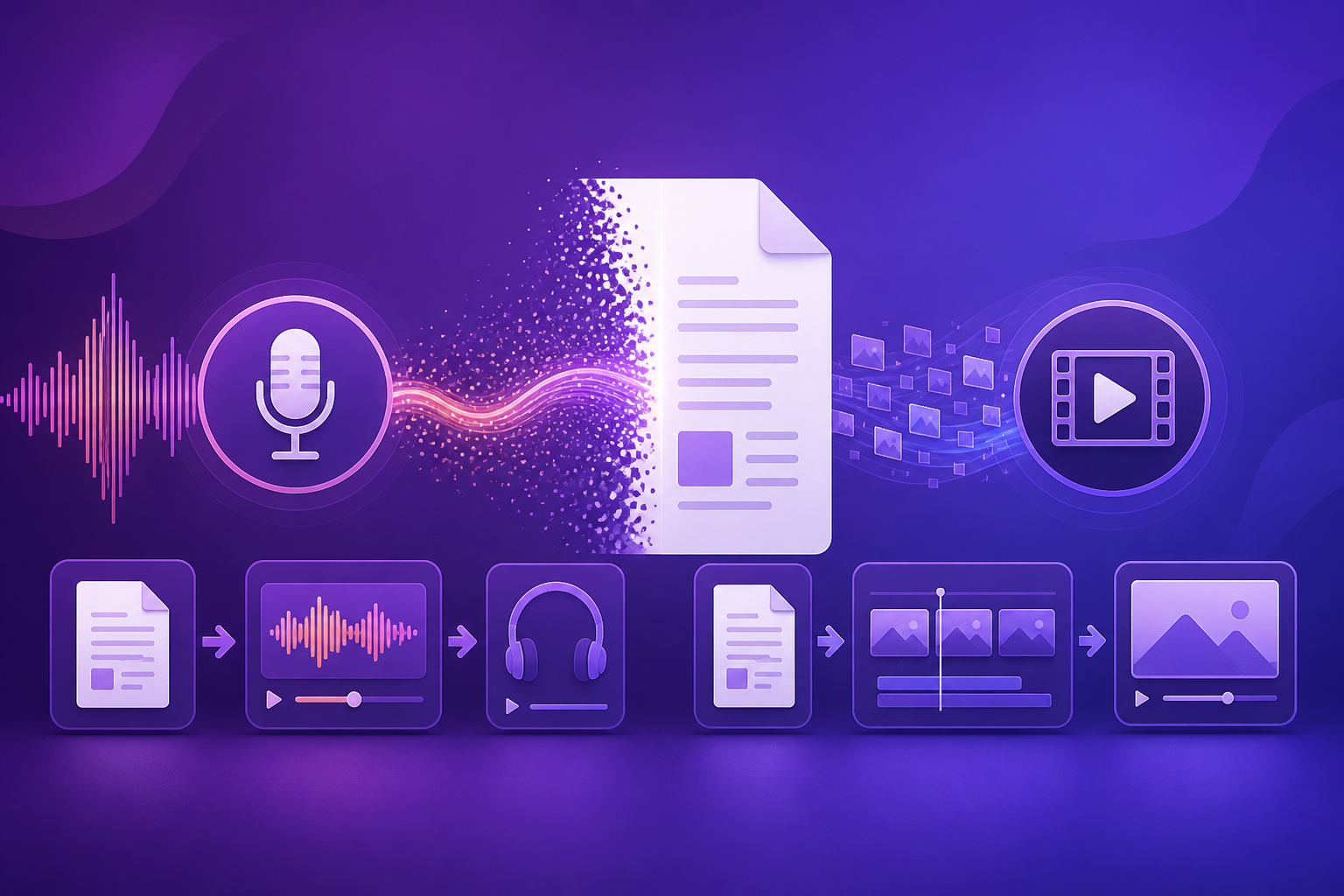
Both turn a document into something you listen to. Only one of them can show you the chart the paragraph is about.
Where audio is genuinely better
Audio is the only format that works while your eyes are busy. Commuting, walking, cooking, exercising — the whole category of time that reading cannot occupy and video cannot either. For a report you personally need to get through, converting it to audio adds usable hours to the week.
It is also the accessible default for people who find sustained reading difficult, and it is cheap: no visuals to design, no aspect ratios, no thumbnails.
Where audio falls apart
Anything visual. A narrator reading 'as Figure 3 shows, the effect concentrates in the upper quartile' to someone with no Figure 3 has communicated nothing. Documents that lean on charts, diagrams, tables, or spatial arrangement lose their evidence entirely in audio.
Numbers are a related problem. Spoken figures do not stick — a listener will not retain 'a 34 per cent increase against a 12 per cent baseline' without seeing it. Video solves this by putting the number on screen while it is said.
- Narrative and argumentative documents — audio is fine.
- Anything with a chart carrying the finding — audio loses the finding.
- Numeric comparisons — need to be seen to be retained.
- Step-by-step or spatial instructions — need to be shown.
The distribution difference
Audio has almost no discovery surface. There is no feed where an MP3 autoplays, and podcast platforms want a show, not a file. Realistically, audio is something you send to someone who already wants it.
Video plays inline everywhere — LinkedIn, YouTube, embedded in a page, in an email preview. If the goal is reaching people who do not know they want your document yet, that gap decides it.
Browser voices versus rendered narration
One practical note for anyone about to try this. Browser and operating-system speech synthesis plays instantly and costs nothing, and it is genuinely fine for personal listening — our free tool does exactly this.
It also cannot be saved: the Web Speech API provides no capture channel, so no in-browser tool can hand you an MP3. That is an API limitation rather than a paywall, and it is why any downloadable audio has to be synthesised server-side.
The straightforward rule
Audio for consuming documents yourself. Video for distributing them to others. If a document has a chart that carries its finding, video regardless of who it is for.
Frequently Asked Questions
Can I download a PDF as an MP3 for free?
Not from a browser-based tool — the speech API cannot be recorded. Server-side services can, and most free tiers cap the length.
Are AI voices good enough for a professional audio version?
Studio-grade synthesis is, for explanatory content. Your device's built-in voices are not — they are for personal listening.
Can I have both from one document?
Yes, and it is the efficient path: the narration track from a rendered video is the audio version, so one script produces both.